服務專線:0800.898.178 info@jnhtech.com.tw


臨床前螢光成像染料專家 | Viscover Chemistry
Preclinical Application-Specific Fluorescent Dyes
Viscover™ 成像化學 (Viscover™ Imaging Chemistry)
應用專屬螢光染料 (Application-Specific Fluorescent Dyes)
Viscover 為您的研究提供完整的碳花青基螢光染料產品組合,涵蓋從可見光(VIS, Visible)到近紅外光(NIR, Near Infrared)的不同光譜範圍,讓您選擇最適合您應用需求的染料。
FluoroWave 試劑是攜帶特定功能基團的小分子螢光染料。無論您是進行實驗室或體外分析(in vitro assays)、體內成像(in vivo imaging)還是離體研究(ex vivo studies),FluoroWave 系列都能提供滿足您特定需求的試劑。
Viscover FluoroWave 染料特性 (FluoroWave Dye Features)
多功能性 (High Versatility)
因具有不同功能基團而具備高度多功能性
雙功能配置 (Bifunctional Configuration)
可提供具有單一或異質反應基團的雙功能染料
高螢光強度 (High Fluorescence Intensity)
展現卓越的螢光強度表現
水溶性穩定 (Aqueous Stability)
在水性緩衝系統中可溶且穩定
點擊化學相容 (Click Chemistry Compatible)
可透過點擊化學輕鬆與其他部分偶聯
肽合成穩定 (SPPS Stable)
在固相肽合成條件下保持穩定
完整研究流程 (Complete Workflow)
可組合使用,實現從實驗室到臨床前階段的單一研究
FluoroWave 產品規格 (Product Specifications)
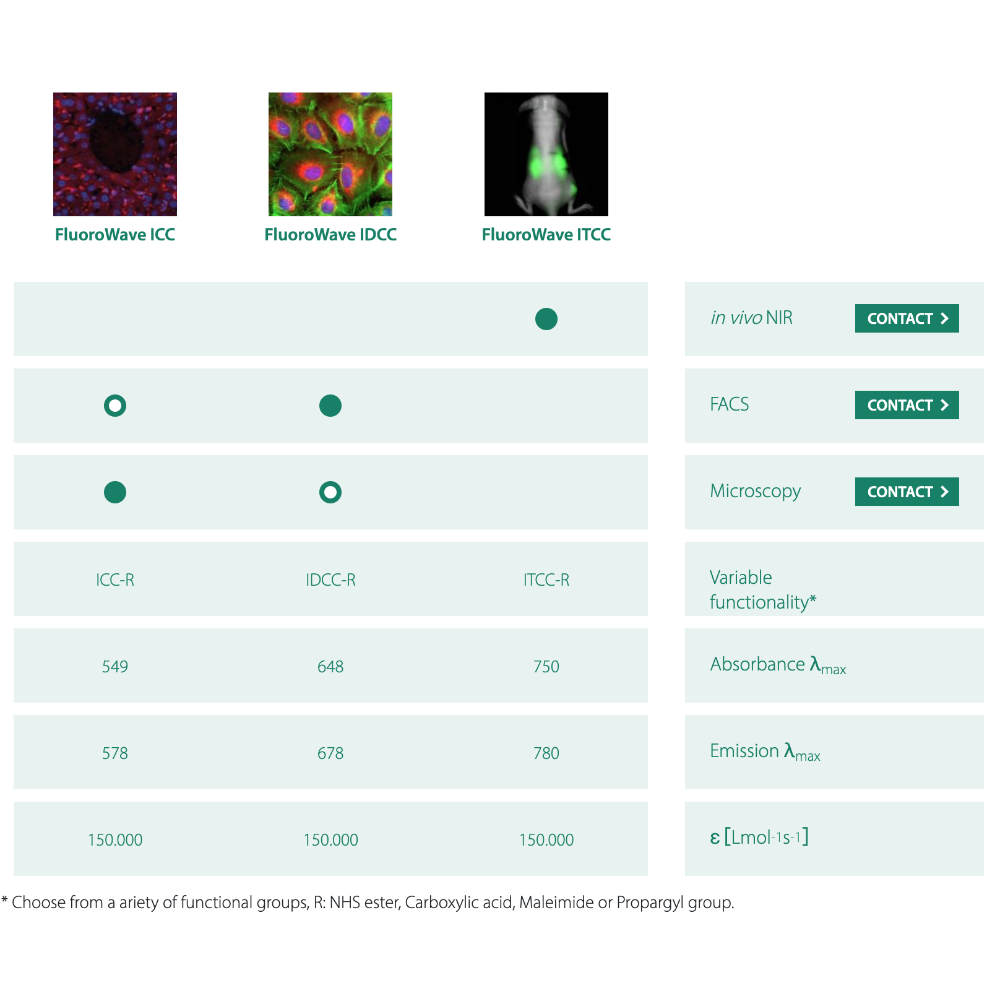
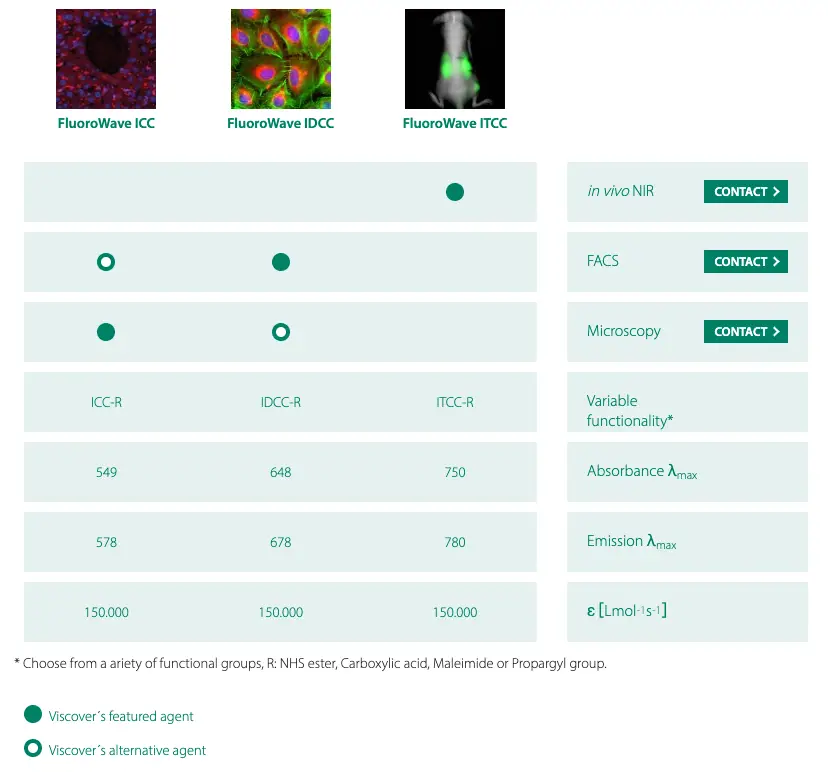
| 產品名稱 (Product Name) | 功能基團 (Functional Group)* | 吸收波長 (nm) (Absorption λmax) | 發射波長 (nm) (Emission λmax) | 消光係數 (Extinction Coefficient) |
|---|---|---|---|---|
| FluoroWave ICC | ICC-R | 549 | 578 | 150,000 |
| FluoroWave IDCC | IDCC-R | 648 | 678 | 150,000 |
| FluoroWave ITCC | ITCC-R | 750 | 780 | 150,000 |
* 可選擇多種功能基團 (Choose from a variety of functional groups), R = NHS ester(活性酯), Carboxylic acid(羧酸), Maleimide(馬來醯亞胺)或 Propargyl group(炔丙基)
光譜範圍說明 (Spectral Range Description)
- FluoroWave ICC:可見光範圍 (Visible Range),適用於標準螢光顯微鏡和流式細胞術
- FluoroWave IDCC:紅光範圍 (Red Range),適合深層組織穿透和多重標記
- FluoroWave ITCC:近紅外範圍 (Near-Infrared Range),最佳體內成像選擇,組織穿透深度最深
應用我們的 FluoroWave 染料於 (Apply Our FluoroWave Dyes To)
01
分子標記 (Molecular Labeling)
輕鬆標記您的特定靶向分子 (Easily label your specific targeting molecule)
02
多元分析平台 (Multi-Platform Analysis)
進行顯微分析 (Microscopic analysis)、流式細胞分選研究 (FACS studies)、臨床前研究 (Preclinical studies) 或其組合應用
03
生物過程視覺化 (Biological Process Visualization)
視覺化和研究各種生物過程 (Visualize and investigate various biological processes)
常見問題 (Frequently Asked Questions)
探索 FluoroWave 的優勢 (Discover the Benefits)
探索您如何從我們的 FluoroWave 染料中受益!無論您是進行基礎研究、藥物開發還是臨床前評估,FluoroWave 系列都能提供可靠的螢光標記解決方案。從可見光到近紅外光的完整光譜覆蓋,配合多樣化的功能基團選擇,讓您的研究更加靈活高效。
如需指定單功能或雙功能 FluoroWave 染料的反應基團規格,請與我們聯繫。我們的技術團隊將協助您選擇最適合您研究需求的染料配置。
產品諮詢與訂購
如需更多產品資訊或技術支援
請聯繫博克科技
☎ 0800-898-178
Viscover FluoroWave Fluorescent Dyes - Comprehensive Product Overview
Introduction to Viscover Imaging Chemistry
Viscover provides cutting-edge imaging chemistry solutions for preclinical research through its innovative FluoroWave fluorescent dye portfolio. As a leading provider of carbocyanine-based fluorescent dyes, Viscover supports researchers worldwide with application-specific imaging agents that span the complete spectral range from visible (VIS) to near-infrared (NIR) wavelengths. The FluoroWave series represents a breakthrough in molecular imaging technology, offering researchers unprecedented flexibility and performance in labeling and visualization applications.
FluoroWave Product Line: Advanced Carbocyanine Fluorescent Dyes
The FluoroWave product family consists of small molecular fluorescent dyes engineered with specific functional groups to meet diverse research requirements. These versatile imaging agents are designed to excel across multiple experimental platforms, from laboratory bench-top assays to sophisticated in vivo imaging studies. Whether conducting in vitro analyses, performing preclinical in vivo imaging, or executing ex vivo investigations, FluoroWave dyes deliver consistent, reliable performance that researchers can depend on throughout their experimental workflows.
Technical Excellence and Key Features
FluoroWave dyes are characterized by their exceptional technical specifications and user-friendly properties. With extinction coefficients reaching 150,000, these dyes exhibit remarkably high fluorescence intensities that enable sensitive detection even at low concentrations. The carbocyanine backbone provides excellent photostability, ensuring consistent signal quality throughout extended imaging sessions. All FluoroWave variants demonstrate superior solubility and stability in aqueous buffer systems, facilitating straightforward handling and storage procedures.
The modular design of FluoroWave dyes incorporates various reactive functional groups, including NHS esters for amine-reactive labeling, carboxylic acids for EDC-mediated conjugation, maleimides for thiol-selective modification, and propargyl groups for click chemistry applications. This functional group diversity enables researchers to select the most appropriate chemistry for their specific biomolecular targets, whether labeling proteins, peptides, nucleic acids, or other biological molecules.
Product Specifications and Spectral Properties
The FluoroWave portfolio comprises three distinct spectral variants, each optimized for specific imaging applications. FluoroWave ICC operates in the visible spectrum with absorption maximum at 549 nm and emission maximum at 578 nm, making it ideal for standard fluorescence microscopy and flow cytometry applications. FluoroWave IDCC occupies the red spectral region with absorption at 648 nm and emission at 678 nm, providing enhanced tissue penetration and reduced autofluorescence interference compared to shorter wavelength dyes.
FluoroWave ITCC represents the near-infrared variant, featuring absorption at 750 nm and emission at 780 nm. This spectral positioning offers maximum tissue penetration depth and minimal background interference from biological autofluorescence, establishing ITCC as the optimal choice for deep-tissue in vivo imaging applications. All three variants maintain identical extinction coefficients of 150,000, ensuring comparable brightness and detection sensitivity across the entire product line.
Versatile Applications Across Research Disciplines
FluoroWave dyes serve diverse applications throughout the biomedical research landscape. In cellular and molecular biology, these dyes facilitate precise labeling of targeting molecules, enabling researchers to track specific proteins, receptor ligands, or other biomolecules with exceptional spatial and temporal resolution. The compatibility with click chemistry protocols streamlines bioconjugation workflows, allowing efficient coupling to peptides, antibodies, or small molecules without compromising biological activity.
For microscopy applications, FluoroWave dyes provide brilliant, photostable signals suitable for confocal imaging, two-photon microscopy, and super-resolution techniques. In flow cytometry, the high fluorescence intensity and narrow emission profiles enable clear discrimination of labeled cell populations, even in complex multiparameter analyses. The aqueous stability and compatibility with standard fixation protocols further enhance the utility of FluoroWave dyes in these analytical platforms.
Preclinical In Vivo Imaging Capabilities
FluoroWave dyes excel in preclinical in vivo imaging studies, where their spectral properties and chemical characteristics combine to deliver superior performance. The near-infrared ITCC variant proves particularly valuable for whole-animal imaging, offering deep tissue penetration that enables visualization of internal organs and pathological processes without invasive procedures. The exceptional photostability of carbocyanine fluorophores ensures robust signal retention throughout longitudinal imaging studies, supporting repeated measurements in the same subjects over extended time courses.
The water solubility and stability of FluoroWave dyes facilitate straightforward formulation for in vivo administration, whether through intravenous injection, local application, or conjugation to targeting vehicles such as nanoparticles or liposomes. The biocompatibility of these imaging agents minimizes perturbation of physiological processes, enabling accurate assessment of biological phenomena in living systems.
Bifunctional and Customizable Options
Beyond monofunctional variants, FluoroWave dyes are available as bifunctional reagents bearing two reactive groups. These dual-functional dyes enable sophisticated labeling strategies, including the creation of multivalent conjugates, construction of fluorescent crosslinkers, or simultaneous attachment to different biomolecular targets. Heterobifunctional options, featuring two distinct reactive groups, provide additional flexibility for sequential or orthogonal conjugation schemes.
Viscover offers comprehensive customization services to meet specific research requirements. Researchers can specify particular reactive group combinations, request modifications to optimize solubility or stability characteristics, or develop entirely novel functional group configurations. This customization capability ensures that FluoroWave dyes can be tailored precisely to demanding experimental protocols or unique molecular targets.
Compatibility with Solid-Phase Peptide Synthesis
A distinctive advantage of FluoroWave dyes lies in their stability under solid-phase peptide synthesis (SPPS) conditions. This compatibility enables direct incorporation of fluorescent labels during peptide assembly, eliminating the need for separate post-synthetic labeling steps. The chemical robustness of carbocyanine fluorophores withstands the repeated acidic deprotection and coupling cycles inherent to SPPS, ensuring that fluorescence properties remain intact throughout the synthesis process.
This SPPS compatibility streamlines the production of fluorescent peptide probes, therapeutic peptide candidates bearing imaging modalities, or fluorescently labeled peptide libraries for screening applications. The ability to incorporate FluoroWave dyes at any position within a peptide sequence provides maximum flexibility in probe design, whether labeling N-termini, C-termini, or internal residues.
Integrated Workflows from Laboratory to Preclinical Studies
One of the most compelling advantages of the FluoroWave product line is the ability to maintain consistency across different experimental stages. Researchers can initiate studies using FluoroWave ICC for in vitro cellular assays and microscopy, transition to IDCC for ex vivo tissue analysis, and ultimately employ ITCC for preclinical in vivo imaging studies—all while using chemically related fluorophores with similar conjugation chemistry and handling characteristics.
This seamless integration across experimental platforms accelerates research timelines, reduces protocol development overhead, and enhances data comparability throughout the research continuum. By eliminating the need to switch between disparate fluorophore families with different chemical properties and labeling protocols, FluoroWave dyes simplify experimental design and execution from initial concept through preclinical validation.
Quality Assurance and Technical Support
All FluoroWave products undergo rigorous quality control testing to ensure consistent performance characteristics. Each lot is verified for spectral properties, extinction coefficient, chemical purity, and functional group reactivity. Detailed certificates of analysis accompany every shipment, providing researchers with complete documentation of product specifications and performance parameters.
Viscover maintains a team of experienced technical specialists available to provide expert guidance on dye selection, conjugation protocols, imaging parameters, and troubleshooting. This comprehensive technical support ensures that researchers can maximize the utility of FluoroWave dyes in their specific applications, whether addressing routine labeling tasks or developing innovative new imaging methodologies.
Conclusion: Advancing Molecular Imaging Research
The Viscover FluoroWave fluorescent dye portfolio represents a comprehensive solution for modern molecular imaging research. By combining exceptional optical properties, diverse functional group options, and compatibility with multiple experimental platforms, these carbocyanine-based imaging agents empower researchers to visualize and investigate biological processes with unprecedented clarity and precision. Whether conducting fundamental cell biology research, developing new therapeutic agents, or validating preclinical disease models, FluoroWave dyes provide the imaging capabilities necessary to advance scientific understanding and accelerate biomedical discovery.