服務專線:0800.898.178 info@jnhtech.com.tw





Sunny Suite
Sunshine — LNP 製程開發/優化平台
三種模組化組態對應快速封裝、條件優化到在線稀釋需求,一台系統陪伴您的奈米藥物從實驗室走向 GMP 量產
產品概述
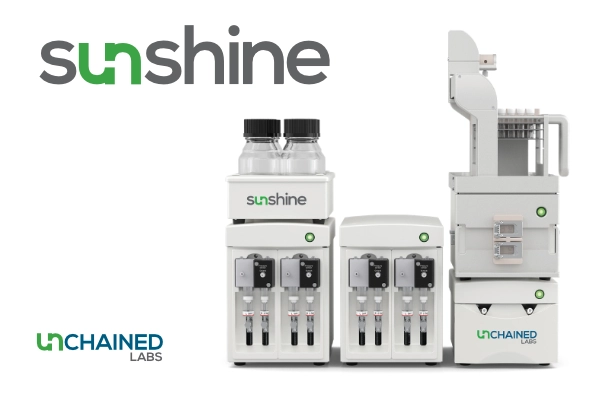
Sunshine 是 Unchained Labs 推出的全方位奈米顆粒製程開發與優化平台,專為脂質奈米顆粒(LNP)、脂質體(Liposome)及聚合物奈米顆粒(Polymer Nanoparticle)的研發與生產而設計。
透過結合自動化的「Protocol Mode」與大量生產的「Continuous Mode」,Sunshine 讓研究人員能夠精準優化「Flow Rate Ratio(FRR)」、「Total Flow Rate(TFR)」與「In-line Dilution」等關鍵製程參數,確保奈米顆粒的粒徑、多分散指數(PDI)與包封率(Encapsulation Efficiency)達到理想標準。
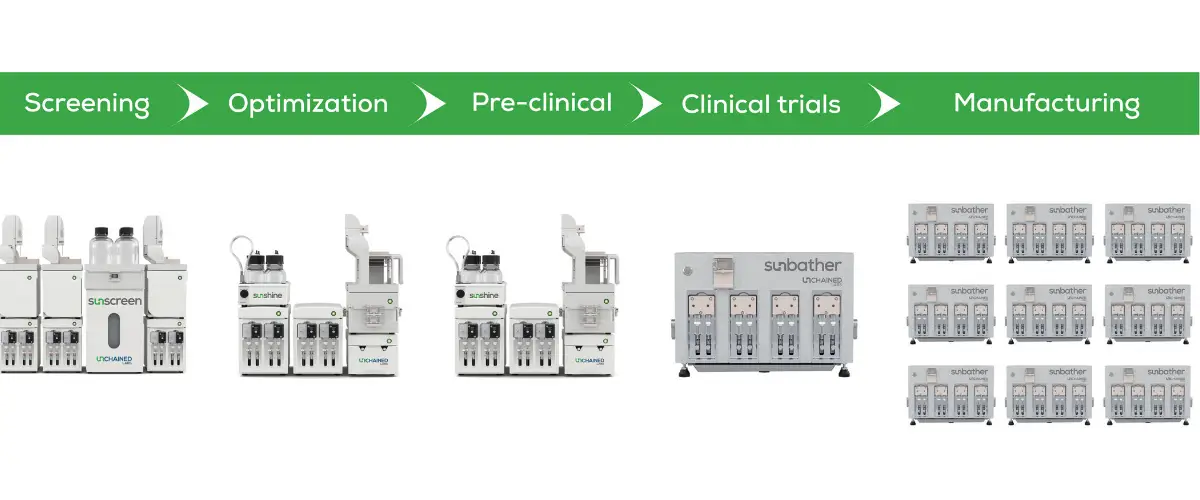
作為 Sunny Suite 產品線的核心成員,Sunshine 完美銜接上游的 Sunscreen 高通量配方篩選與下游的 Sunbather GMP 生產系統,是奈米藥物從實驗室走向臨床試驗的關鍵橋樑。
核心優勢
01
自動化奈米顆粒開發
Automated nanoparticle development
02
完全可重複使用的微流體晶片
Fully reusable microfluidics
03
400 µL 至連續流量產
Options from 400 µL to continuous flow
04
自動化清洗流程
Automated cleaning
05
無縫轉移至 GMP 生產
Direct transfer to GMP
三種配置,滿足不同研發階段
無論您處於哪個開發階段,Sunshine 都有對應的配置方案。隨著需求變化,系統可靈活升級,無需購買全新儀器。
全功能版
Sunshine
從開發到量產的完整解決方案
- 具備 Sunshine Lite 所有功能
- In-line Dilution 在線稀釋功能
- 即時調整 pH 與降低溶劑濃度
- 維持奈米顆粒穩定性
- 適合前臨床生產與 GMP 轉移準備
Typical volume: ≥1 mL Continuous flow: up to tens of liters/day

Sunshine Lite
條件篩選與連續生產兼備
- Protocol Mode 自動執行多組實驗
- Continuous Mode 支援大量生產
- 自動化樣本收集功能
- 15 分鐘完成 10 組參數測試
- 適合製程條件優化階段
Typical volume: ≥1 mL Throughput: 10 samples in 15 minutes
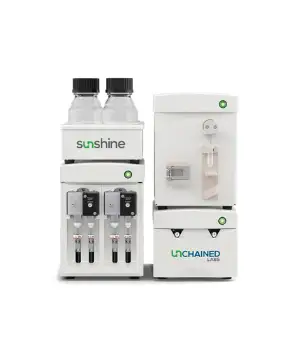
Sunshine Single
快速封裝,珍貴樣本的最佳選擇
- 專為單次實驗設計,操作簡便
- 最低樣本量僅需 400 µL
- 5 分鐘內完成單次實驗
- 縮短流路設計,維持高樣本回收率
- 適合早期酬載開發與快速驗證
Typical volume: 0.4–6.3 mL Throughput: 1 sample in 5 minutes
配置功能比較
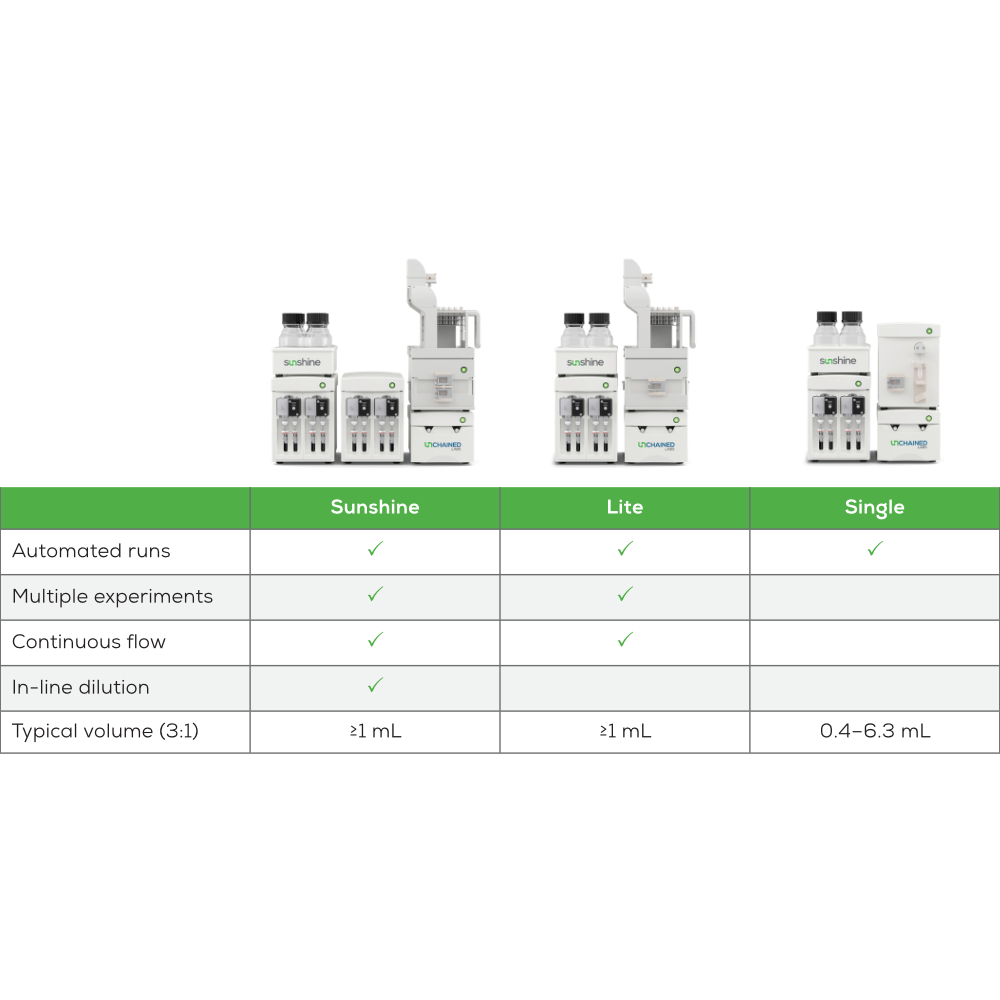
| 功能 | Sunshine | Sunshine Lite | Sunshine Single |
|---|---|---|---|
| Automated runs | ✓ | ✓ | ✓ |
| Multiple experiments | ✓ | ✓ | — |
| Continuous flow | ✓ | ✓ | — |
| In-line dilution | ✓ | — | — |
| Typical volume (3:1 FRR) | ≥1 mL | ≥1 mL | 0.4–6.3 mL |
| Throughput | 10 samples in 15 min | 10 samples in 15 min | 1 sample in 5 min |
核心功能
Protocol Mode — 自動化參數優化
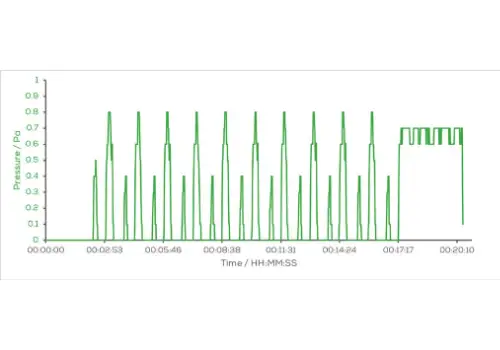
Protocol Mode 讓研究人員能夠從同一組試劑中自動執行多個實驗,每個實驗可設定不同的「Flow Rate Ratio(FRR)」、「Total Flow Rate(TFR)」與「Dilution Ratio」。系統會依序完成實驗、自動清洗流路,並收集樣本至指定位置。
15 分鐘 完成 10 組實驗
320 µL 最低試劑用量/實驗
<0.2 PDI 穩定的多分散指數
可優化的關鍵參數
- Flow Rate Ratio (FRR):調整水相與有機相比例,控制奈米顆粒粒徑
- Total Flow Rate (TFR):改變總流速以影響混合時間與粒子大小
- Dilution Ratio:在線稀釋調整 pH 值與溶劑濃度
- N/P Ratio:優化陽離子脂質與核酸磷酸根的電荷比
Continuous Mode — 連續生產模式
當最佳製程條件確定後,Sunshine 可無縫切換至 Continuous Mode,以相同的流速參數進行大規模連續生產。系統每天可產出數十公升的奈米顆粒懸浮液,且粒子品質與 Protocol Mode 實驗結果高度一致。
產能彈性
從 1 mL 樣本到數十公升連續生產,滿足不同規模需求
品質一致性
微量實驗與大規模生產使用相同參數,確保粒子特性零落差
即時監控
系統壓力即時監測,確保製程穩定運行
技術優勢
可重複使用的 Sunnies 微流體晶片
Sunnies 晶片採用高精度玻璃材質製成,提供極度平滑的流道表面,確保層流混合的穩定性與可重複性。晶片可自動化清洗並無限次重複使用,大幅降低耗材成本與塑膠廢棄物。
可選晶片類型
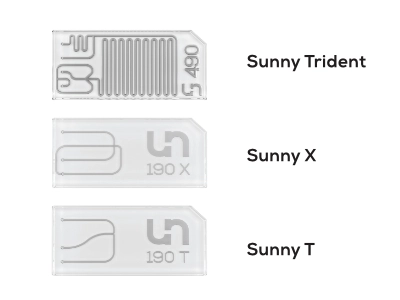
- Sunny Trident:Reverse-angle mixing,支援 In-line dilution
- Sunny X:Cross-type mixing,多種通道尺寸
- Sunny T:T-mixing,多種通道尺寸
Wetted Materials
PTFE, PCTFE, FEP, ETFE, PEEK, Polypropylene, FFKM, Hastelloy C276, Stainless Steel T316, Glass, Tygon (waste tubes), PET (waste bottle)
共 9 種晶片幾何構造可選:Sunny 490 Trident T, Sunny 100 X, Sunny 100 T, Sunny 190 X, Sunny 190 T, Sunny 275 X, Sunny 275 T, Sunny 150 3D, Sunny 50 Micromixer 了解更多

Hydrodynamic Flow Focusing 技術
Sunshine 採用「Hydrodynamic Flow Focusing」層流聚焦技術,將脂質/有機相與 mRNA/水相以穩定的層流方式匯聚於 Sunnies 晶片接合處。試劑透過擴散作用相互混合,降低脂質溶解度並驅動奈米顆粒自組裝,產生高度均一且可調控的 LNP。
精準控制
透過調整流速即可精確調控粒徑大小
低剪切力
相較於撞擊噴射混合,對 mRNA 更為溫和
高重現性
穩定的層流條件確保批次間一致性
Sunny Suite — 端到端的奈米顆粒開發解決方案
應用文獻
探索 Sunshine 在不同奈米顆粒類型的應用案例與實驗數據
01
多元奈米顆粒的彈性開發與製程放大
Flexible nanoparticle development: process optimization & scale-up of a wide range of synthetic nanomedicines with Sunshine
本應用文獻展示 Sunshine 如何靈活應用於多種奈米材料的開發,包括 PLGA 奈米顆粒、磷脂質脂質體(Phospholipon-based Liposomes)、DMPC/Cholesterol 脂質體,以及 SM-102 與 DOTAP 為基底的 mRNA-LNP 配方。透過調整 FRR 與 TFR,所有粒子皆可控制在 20–150 nm 範圍內,PDI 小於 0.2,包封率超過 90%。
- PLGA nanoparticles: 57–83 nm, PDI <0.1
- mRNA-LNP (SM-102): 58–68 nm, EE% >90%
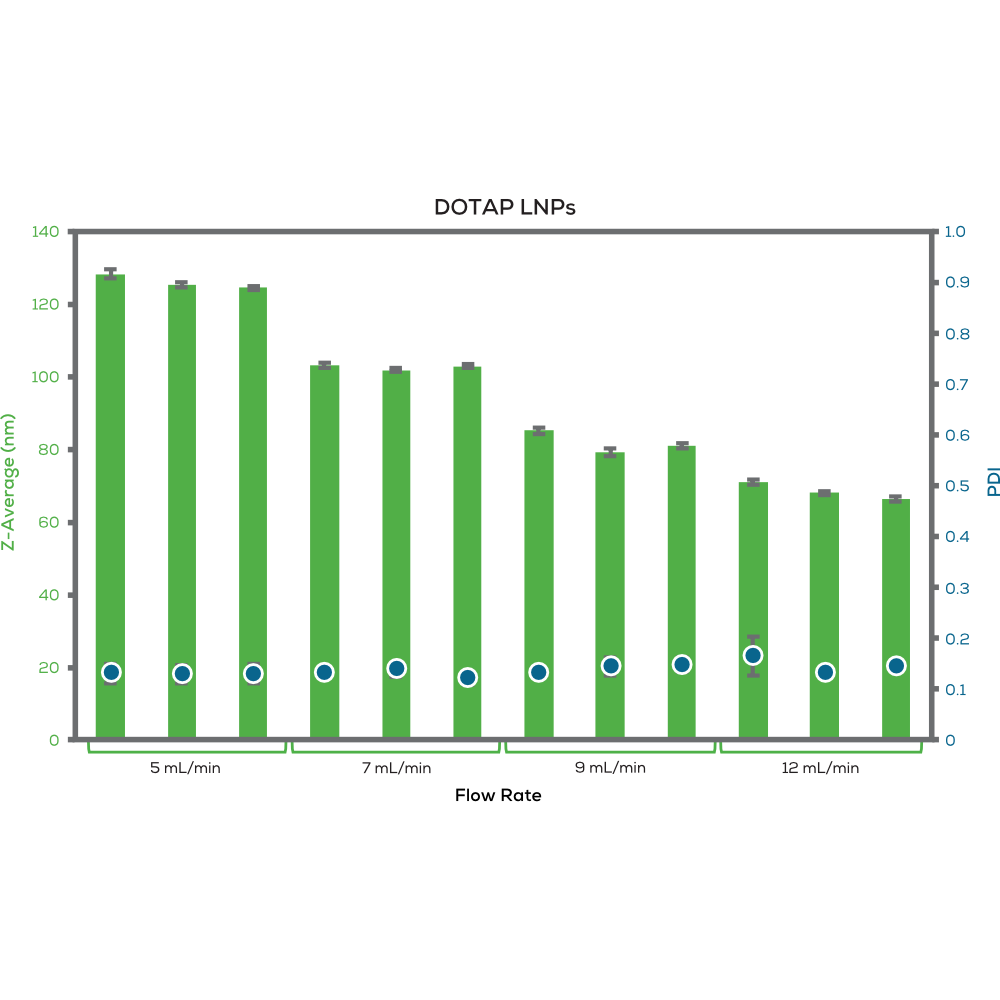
- Poly(A)-LNP (DOTAP): 66–128 nm, RSD <4%
02
LNP 製程優化與前臨床生產
Process optimization and pre-clinical production of lipid nanoparticles using Sunshine
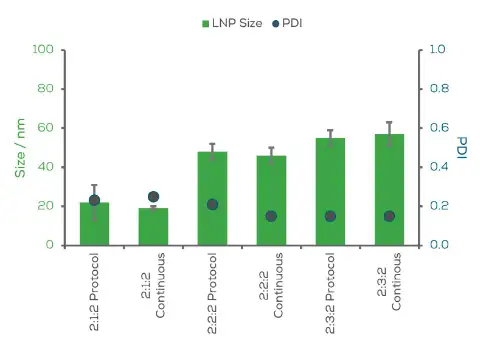
本應用文獻詳述如何使用 Sunshine 優化 mRNA-LNP 的製程參數,以達成目標粒徑約 60 nm、PDI 小於 0.1、包封率超過 90% 的品質標準。文中示範了 FRR(2:1 至 6:1)與 TFR(2.5 至 12.5 mL/min)對粒子特性的影響,並驗證 Protocol Mode 與 Continuous Mode 產出粒子的一致性。
- 最佳條件:TFR 7.5 mL/min, FRR 3:1
- 粒徑 57.7 nm, PDI 0.089, EE% 94.7%
- Protocol vs Continuous:粒徑差異 <7 nm
03
三種配置的效能驗證
Therapeutic nanoparticle prep that meets you where you're at with Sunshine
本應用文獻比較 Sunshine、Sunshine Lite 與 Sunshine Single 三種配置在相同條件下的 LNP 產出表現。使用 Spikevax 配方(SM-102 為基底)與 PolyA 作為模擬酬載,驗證三種配置在各流速下皆能產出一致的粒徑(85–170 nm)與極高的包封率(>98%)。
- 三種配置粒徑差異在標準誤差範圍內
- 所有條件包封率 >98%
- 最低樣本量 400 µL,含頭尾切除
Specifications
Application
| Parameter | Sunshine | Sunshine Lite | Sunshine Single |
|---|---|---|---|
| Throughput | 10 samples in 15 minutes | 10 samples in 15 minutes | 1 sample in 5 minutes |
| Total flow rate range (Sunnies dependent) | 0.1–30 mL/min | 0.1–20 mL/min | 0.1–20 mL/min |
| Typical sample volume (3:1 FRR) | ≥1 mL | ≥1 mL | 0.4–6.3 mL |
| Minimum input volume (including dead volume) | ≥170 µL | ≥170 µL | ≥170 µL |
| Continuous mode | Yes | Yes | No |
| In-line dilution | Yes | No | No |
Common Specifications (All Configurations)
| Flow rate ratio range (aqueous to organic) | 1:1 to 10:1 |
|---|---|
| Typical particle size | 40–200 nm* |
| PDI | <0.2* |
| Encapsulation efficiency | >90%* |
* Formulation dependent
Instrument
| Parameter | Sunshine | Sunshine Lite | Sunshine Single |
|---|---|---|---|
| Weight and dimensions | 31 kg, 53 H x 60 W x 40 D cm | 23 kg, 53 H x 40 W x 40 D cm | 20 kg, 35 H x 40 W x 40 D cm |
| Voltage input | 100 V–240 V AC, 50–60 Hz | ||
| Communications | USB | ||
| Sample loop size | 1, 5 and 10 mL | 1, 5 and 10 mL | 5 mL |
| Computer | Separate computer with Win 11, monitor, keyboard and mouse (not included in Dimensions) | ||
Wetted Materials
PTFE, PCTFE, FEP, ETFE, PEEK, Polypropylene, FFKM, Hastelloy C276, Stainless Steel T316, Glass, Tygon (waste tubes), PET (waste bottle)
Consumables
| Sunnies | Glass microfluidic mixing devices of various geometries and channel sizes — 了解更多 |
|---|---|
| Available types | Sunny 490 Trident T, Sunny 100 X, Sunny 100 T, Sunny 190 X, Sunny 190 T, Sunny 275 X, Sunny 275 T, Sunny 150 3D, Sunny 50 Micromixer |
常見問題
Sunshine LNP Process Development and Optimization Platform by Unchained Labs
Sunshine is a comprehensive nanoparticle process development and optimization platform from Unchained Labs, designed specifically for lipid nanoparticles (LNPs), liposomes, and polymer nanoparticles used in therapeutic drug delivery applications. As a core member of the Sunny Suite product line, Sunshine bridges the gap between high-throughput formulation screening with Sunscreen and GMP-compliant clinical manufacturing with Sunbather.
The Sunshine platform leverages advanced microfluidic technology based on hydrodynamic flow focusing to achieve precise, reproducible nanoparticle synthesis. By combining reagents in a controlled laminar flow environment within Sunnies microfluidic chips, researchers can produce highly uniform nanoparticles with narrow size distributions (PDI less than 0.2) and excellent encapsulation efficiencies exceeding 90 percent.
Three Flexible Configurations
Sunshine is available in three modular configurations to meet different research and development needs. Sunshine Single is designed for rapid, single-experiment payload encapsulation with sample volumes as low as 400 microliters, completing each run in under 5 minutes. This configuration is ideal for early-stage payload development where precious nucleic acid constructs require quick encapsulation for performance testing.
Sunshine Lite adds automated experiment sequencing through Protocol Mode, enabling researchers to automatically execute multiple experiments with varying flow rate ratios (FRR), total flow rates (TFR), and dilution parameters. The system can complete 10 different experiments in just 15 minutes from a single reagent loading step. Sunshine Lite also supports continuous production mode for generating larger volumes of nanoparticles.
The full-featured Sunshine configuration includes all capabilities of Sunshine Lite plus in-line dilution functionality. This critical feature allows real-time pH adjustment and solvent concentration reduction during particle formation, essential for maintaining nanoparticle stability and preparing for downstream processing.
Protocol Mode for Automated Parameter Optimization
Protocol Mode enables systematic exploration of process parameters with minimal hands-on time. Researchers can define experiment tables specifying different FRR, TFR, and dilution conditions, and the system automatically executes each experiment, performs flowpath cleaning, and collects samples to designated locations. This automated approach significantly accelerates process optimization while ensuring reproducibility.
Key parameters that can be optimized include flow rate ratio (controlling aqueous to organic phase proportions), total flow rate (affecting mixing time and particle size), dilution ratio (for pH and solvent adjustment), and N/P ratio (optimizing cationic lipid to nucleic acid charge ratio). Application data demonstrates that mRNA-LNP particle size can be precisely controlled from 58 to 94 nanometers by varying TFR from 2.5 to 10 milliliters per minute, with PDI values consistently below 0.15.
Continuous Mode for Scale-Up Production
Once optimal process conditions are identified, Sunshine seamlessly transitions to Continuous Mode using identical flow parameters. This capability allows production of tens of liters of nanoparticle suspension per day, sufficient for pre-clinical trials and extensive downstream characterization. Particle quality remains consistent between Protocol Mode experiments and Continuous Mode production, with size differences typically less than 7 nanometers.
Reusable Sunnies Microfluidic Chips
Sunshine utilizes Sunnies microfluidic mixing chips manufactured from high-precision glass with ultra-smooth channel surfaces. These chips support automated cleaning and can be reused indefinitely, dramatically reducing consumable costs and plastic waste. Nine different chip geometries are available including Sunny Trident (reverse-angle mixing with in-line dilution), Sunny X (cross-type mixing), and Sunny T (T-mixing), with multiple channel sizes to suit various applications.
Broad Application Range
Sunshine has been validated for producing diverse nanoparticle types including mRNA-LNPs using ionizable lipids such as SM-102 and cationic lipids like DOTAP, PEGylated liposomes based on DMPC and cholesterol formulations, phospholipid-based liposomes using Phospholipon 90G, and biodegradable polymer nanoparticles including PLGA and PLGA-PEG. The chemically resistant flowpath ensures compatibility with various organic solvents and reagent types.
Seamless GMP Transfer
As part of the Sunny Suite ecosystem, process parameters developed on Sunshine transfer directly to the GMP-compliant Sunbather system. Both platforms utilize identical pumping technology and Sunnies microfluidic chips, minimizing scale-up validation requirements and accelerating the path from development to clinical manufacturing.
Sunshine represents the ideal solution for nanomedicine researchers seeking to optimize lipid nanoparticle formulations for mRNA vaccines, gene therapies, CRISPR delivery systems, and other nucleic acid therapeutics, combining automated process development with scalable production capabilities in a single integrated platform.