服務專線:0800.898.178 info@jnhtech.com.tw




Stunner 生物製劑分析解決方案
濃度定量|聚集檢測|B22/kD 預測|ADC DAR 與 Unmix 光譜解析
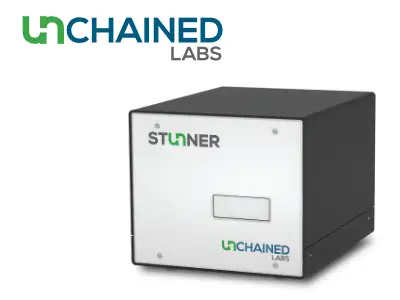
Stunner 是唯一整合「UV/Vis」與「Dynamic Light Scattering, DLS」的微量盤式系統,僅需 2 µL 樣品即可同步獲得蛋白質濃度、粒徑分布與聚集體資訊,為生物製劑開發提供全方位品質監控。
Stunner 核心技術特色
微量樣品需求
僅需 2 µL 樣品即可完成完整分析,無需稀釋或前處理。96 孔微流體盤設計,每個孔位內建兩種光徑(0.1 mm 與 0.7 mm),可涵蓋 0.03-275 OD 的超寬動態範圍。
UV/Vis 與 DLS 整合
Stunner 是市場上唯一能在同一樣品上同時執行「UV/Vis」光譜分析與「Dynamic Light Scattering」的微量盤式系統,單次測量即可獲得濃度、粒徑、多分散性指數(PDI)等關鍵參數。
高通量分析
96 孔盤濃度測量僅需約 10 分鐘,加上 DLS 粒徑分析也只需約 1 小時 完成整盤。支援自動化整合,可連接液體處理機器人擴充產能。
Unmix 光譜解卷積
專為「Antibody-Drug Conjugate, ADC」設計的演算法,可自動分離重疊的吸收光譜,精準區分抗體與「drug-linker」的訊號貢獻,計算準確的「Drug-to-Antibody Ratio, DAR」。
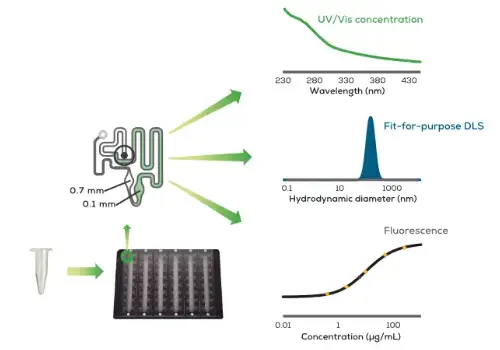
Stunner 96 孔微流體盤內建 0.1 mm 與 0.7 mm 雙固定光徑,涵蓋超寬動態範圍
卓越的定量精準度
Stunner 採用雙固定光徑設計,在低濃度與高濃度樣品皆能提供出色的量測表現。實測數據顯示,IgG 稀釋系列的線性相關係數達 R² = 0.9999,精密度(CV)維持在 1% 以內,準確度則在 2% 以內。
定量規格亮點
- 濃度範圍:0.03-275 mg/mL(以平均蛋白質計算)
- 吸光度精密度(10 mm 光徑):小於 1 OD 時 ±0.01 OD(標準差);1-200 OD 時 ±1% CV
- 吸光度準確度(10 mm 光徑):小於 1 OD 時 ±0.02 OD;1-200 OD 時 ±2%
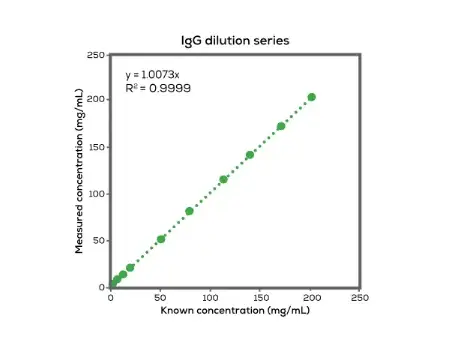
IgG 稀釋系列定量結果:R² = 0.9999,CV 小於 1%
蛋白質聚集風險預測
蛋白質聚集是生物製劑開發中的關鍵挑戰。Stunner 結合 DLS 粒徑分析與膠體穩定性參數測量,協助研究人員在開發早期識別潛在的聚集風險,優化配方設計。
DLS 聚集體偵測
透過「Dynamic Light Scattering」技術,Stunner 可測量蛋白質的「Hydrodynamic Diameter」與「Polydispersity Index, PDI」。切換質量分布(Mass Distribution)與強度分布(Intensity Distribution)視角,即使僅有 1% 的聚集體也能被偵測到。強度分布對大顆粒特別敏感,是早期發現聚集問題的有效工具。
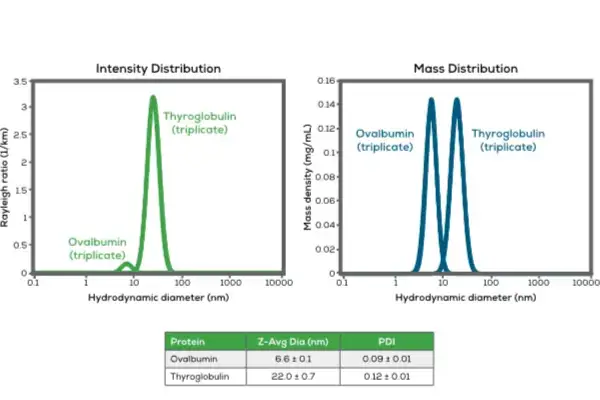
Ovalbumin 與 Thyroglobulin 標準品的 DLS 分析:三重複測量展示優異的重現性
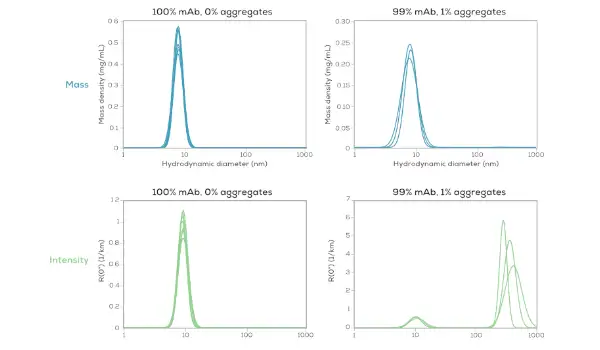
質量分布(Mass)顯示主要單體,強度分布(Intensity)可敏感偵測微量聚集體
B22 第二乙利係數
「Second Virial Coefficient, B22」是描述蛋白質分子間相互作用的熱力學參數。正值代表分子間存在排斥力(有利於穩定),負值則表示分子間具有吸引力(聚集傾向較高)。
Stunner 透過測量不同濃度下的光散射訊號,繪製 KC/R 對濃度的關係圖,由斜率計算 B22。在 PBS 緩衝液中呈現正斜率的 IgG 樣品,相較於在 Succinate 緩衝液中呈現負斜率的樣品,具有更佳的膠體穩定性。
kD 擴散交互作用參數
「Diffusion Interaction Parameter, kD」透過分析不同濃度下蛋白質擴散係數的變化來評估分子間相互作用。正值 kD 代表分子間的淨排斥作用,負值則代表淨吸引作用。
只需準備一組濃度梯度樣品,載入 Stunner 盤中,系統會自動以 UV/Vis 確認實際濃度,同時以 DLS 測量擴散係數,一次實驗即可完成 kD 分析。
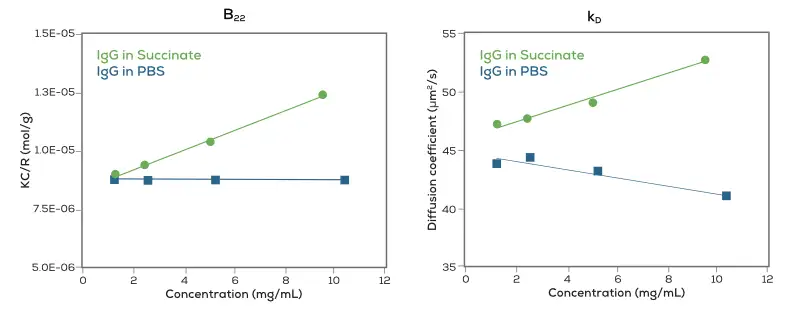
B22 與 kD 分析:正斜率(PBS)代表分子間排斥力,負斜率(Succinate)代表吸引力
ADC 抗體藥物複合體分析
「Antibody-Drug Conjugate, ADC」的 UV/Vis 光譜分析具有挑戰性,因為「drug-linker」的吸收光譜常與抗體在 UV 區域重疊。Stunner 的「Unmix」演算法能自動解卷積複雜光譜,精準定量抗體濃度、藥物濃度與「Drug-to-Antibody Ratio, DAR」。
NEW
ADC Decode 應用程式
2026 年 1 月發布
Unchained Labs 推出全新「ADC Decode」應用程式,專為 Stunner 設計,提供快速、低樣品量的 ADC 表徵分析。即使在開發早期樣品資訊有限的情況下,也能可靠地獲得「Drug-to-Antibody Ratio, DAR」、濃度與粒徑數據。
「ADC Decode」可清晰分離抗體與藥物訊號,解決傳統 UV/Vis 方法難以處理的光譜重疊問題,同時避免傳統分析方法耗時的逐一測量流程。結合 UV/Vis 與「Dynamic Light Scattering」技術,研究人員可快速比較不同接合條件、確認製程步驟間的一致性,並在開發早期做出更明智的決策。
閱讀原廠新聞稿ADC 分析工作流程
1
Store Analyte 建立參考光譜
使用「Store Analyte」功能,測量「drug-linker」稀釋系列的吸收光譜並儲存。同樣方式儲存抗體的參考光譜。此功能可建立自訂的光譜資料庫,適用於任何 ADC 組合。
2
Unmix 光譜解卷積
載入 ADC 樣品後,Stunner 會自動將總吸收光譜(黑線)解卷積為抗體貢獻(綠線)與「drug-linker」貢獻(藍線)。即使光譜高度重疊,也能精準分離各成分訊號。
3
DAR 與濃度計算
根據解卷積結果與各成分的消光係數(E1%),系統自動計算抗體濃度、藥物濃度,並由兩者比值得出 DAR。高通量格式可同時分析 96 個樣品。
4
DLS 同步品質監控
在同一樣品上同步執行 DLS 分析,獲得「Hydrodynamic Diameter」與 PDI,即時確認 ADC 是否發生聚集。單次測量即可完整掌握 DAR、濃度、粒徑與均一性。
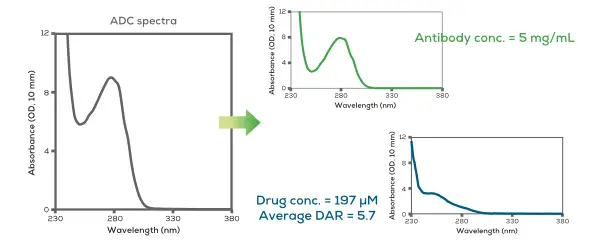
Unmix 將 ADC 總光譜自動解卷積為抗體(綠)與藥物(藍)貢獻,精準計算濃度與 DAR
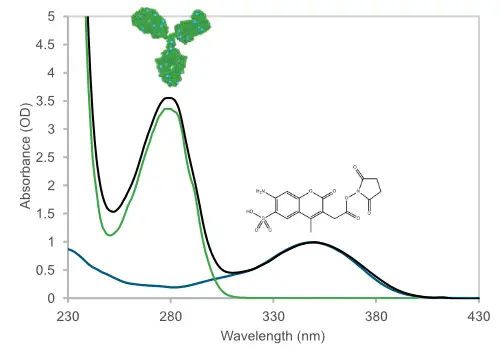
Unmix 演算法分離重疊光譜:黑線為總吸收,綠線為抗體貢獻,藍線為藥物貢獻
ADC 製程開發應用
接合反應優化
測試不同「drug-linker」、莫耳比例與反應條件,快速篩選最佳接合參數以達成目標 DAR。
純化製程監控
追蹤純化前後的 DAR 變化,確認未反應的「drug-linker」已被有效移除,同時監控蛋白質回收率。
批次一致性確認
高通量格式適合批次放行檢測,確保每批 ADC 產品的 DAR、濃度與品質符合規格。
應用說明
Conjugate, Clean-up, & Characterize ADCs on Unagi & Stunner
本應用文獻展示如何結合 Unagi 緩衝液置換系統與 Stunner 進行完整的 ADC 製備與品質分析流程。實驗中使用三種不同的「payload/linker」組合(FITC、Alexa Fluor 350 NHS ester、Alexa Fluor 350 C5 maleimide)與兩種莫耳比例(2:1 與 10:1)製備模型 ADC。
關鍵發現
- Stunner 的「Store Analyte」功能可儲存任何「drug-linker」的參考光譜,建立自訂光譜資料庫
- 透過比較純化前後的 DAR,可評估接合反應效率與純化步驟的有效性
- DLS 分析顯示大多數 ADC 樣品的 PDI 維持在 0.1 以下,證實未發生明顯聚集
- 不同「linker」化學性質(NHS ester vs maleimide)會顯著影響反應效率與最終 DAR
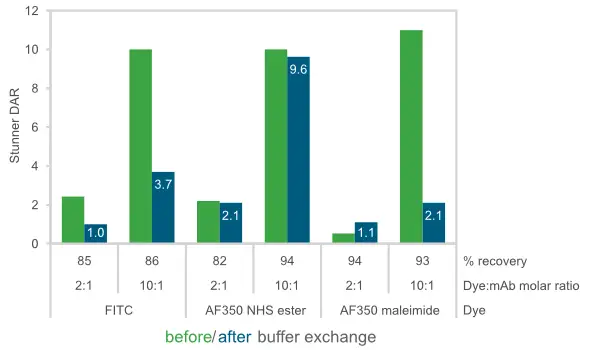
不同 drug-linker 組合的 DAR 結果:綠色為純化前,藍色為純化後,數字標示 % recovery
技術規格
Stunner Instrument Specifications
| Dimensions | 37 cm W x 54 cm D x 33 cm H; 30.4 kg |
| Electrical | Universal input voltage 100-240 V AC, 50-60 Hz |
| Computer | Separate computer with Windows 11 included |
| Approval | CE, FCC, CSA |
| Regulatory Compliance | Optional 21CFRp11 software package; USP and Ph. Eur. performance verification standards |
UV/Vis Specifications
| Light Source | Xenon flash lamp |
| Wavelength Range | 230-750 nm |
| Wavelength Accuracy | ≤400 nm: ±1 nm; ≥400 nm: ±2 nm |
| Spectral Resolution | Better than 2 nm (toluene in hexane) |
| Absorbance Precision (1 cm cuvette) | <1 OD: ±0.005 OD st dev; 1-2 OD: ±0.5% CV |
| Absorbance Accuracy (1 cm cuvette) | <1 OD: ±0.01 OD; 1-2 OD: ±1% |
DLS Specifications
| Light Source | 2 x 660 nm laser diodes |
| Detection | Avalanche photodiode module |
| Size Accuracy | ±2% |
| Hydrodynamic Diameter Range | 0.3-1000 nm |
| Molecular Weight Range | 1 kDa - 10 GDa |
| Minimum Sample Concentration | 0.1 mg/mL lysozyme |
Stunner Plate Specifications
| Samples per Plate | 96 (12 x 8 microplate format) |
| Recommended Sample Volume | 2 µL |
| Pathlengths | 0.1 mm & 0.7 mm |
| Measurement Time (Full Plate) | ~10 min (UV/Vis only); ~1 hour (UV/Vis + DLS) |
| Measurement Range | 0.03-275 OD (10 mm); 0.03-275 mg/mL (ave protein mix) |
| Absorbance Precision (10 mm) | <1 OD: ±0.01 OD st dev; 1-200 OD: ±1% CV |
| Absorbance Accuracy (10 mm) | <1 OD: ±0.02 OD; 1-200 OD: ±2% |
常見問題
Stunner: The Only Plate-Based System Combining UV/Vis and DLS for Biologics Characterization
Stunner from Unchained Labs is a revolutionary analytical platform that integrates UV/Vis spectroscopy and Dynamic Light Scattering (DLS) technology in a single, high-throughput microplate-based system. Designed specifically for biologics development and quality control, Stunner enables comprehensive protein characterization using just 2 µL of sample per well, making it the ideal solution for precious samples during early-stage development.
The system features a unique 96-well microfluidic plate design with dual fixed pathlengths (0.1 mm and 0.7 mm), providing an exceptional dynamic range of 0.03-275 OD. This eliminates the need for sample dilution in most applications and ensures accurate concentration measurements across a wide range of protein concentrations. With precision within 1% CV and accuracy within 2%, Stunner delivers publication-quality data for protein quantification.
For aggregation assessment, Stunner's DLS capability measures hydrodynamic diameter and polydispersity index (PDI) simultaneously with concentration. The intensity-weighted size distribution is particularly sensitive to large particles, enabling detection of aggregates even at levels as low as 1%. Researchers can switch between mass and intensity distributions to gain comprehensive insights into sample homogeneity.
Stunner excels in formulation development by measuring colloidal stability parameters B22 (second virial coefficient) and kD (diffusion interaction parameter). These measurements help predict aggregation propensity and guide buffer and excipient selection. A positive B22 or kD indicates net repulsive interactions between protein molecules, suggesting favorable conditions for long-term stability.
For Antibody-Drug Conjugate (ADC) analysis, Stunner's proprietary Unmix algorithm automatically deconvolutes overlapping absorption spectra to separate contributions from the antibody and drug-linker components. The Store Analyte feature allows users to build custom spectral libraries for any drug-linker combination. Combined with extinction coefficients, the system calculates antibody concentration, drug concentration, and Drug-to-Antibody Ratio (DAR) in a single measurement. Simultaneous DLS analysis monitors for aggregation, providing complete ADC characterization in one workflow.
In January 2026, Unchained Labs launched the ADC Decode application, a streamlined solution for rapid ADC screening. ADC Decode delivers reliable DAR, concentration, and size data even when sample information is limited — particularly valuable during early development stages. By cleanly separating antibody and drug contributions without requiring extensive reference spectra, ADC Decode eliminates the complexity of traditional UV/Vis methods and accelerates conjugation comparisons across different process conditions.
Key applications include mAb concentration and purity assessment, formulation screening, process development monitoring, ADC DAR determination, and batch release testing. The high-throughput format processes 96 samples in approximately 10 minutes for UV/Vis only or 1 hour with DLS, supporting both R&D and QC workflows. Optional 21 CFR Part 11 compliant software and USP/Ph. Eur. verification standards meet pharmaceutical regulatory requirements.
Stunner represents a significant advancement in biologics characterization by combining multiple analytical techniques in a single, automated platform. Its minimal sample requirements, broad dynamic range, and comprehensive data output make it an essential tool for biopharmaceutical development from early discovery through commercial manufacturing.